Invoice Template South Africa 2026
Updated for the 2026/2027 tax year. Current VAT rates, SARS requirements, and best practices for South African invoicing.
2026/2027 tax year
VAT remains at 15%. Tax invoices must still comply with Section 20 of the VAT Act 89 of 1991. PAYE tax brackets have been updated. See SARS for current tables.
What's current for 2026
Complete 2026 invoice checklist
Make sure every invoice you issue in 2026 includes these elements:
- Your business name and physical address
- Your contact details (phone, email)
- Your VAT registration number (if VAT registered)
- Client name and details (required for invoices over R5,000)
- Unique, sequential invoice number
- Date of issue
- Clear description of each good or service provided
- Quantity and unit price for each item
- Subtotal excluding VAT
- VAT amount at 15% (if VAT registered)
- Total including VAT
- Your banking details for EFT payment
- Payment terms (e.g., 'Due within 30 days')
Example 2026 invoice
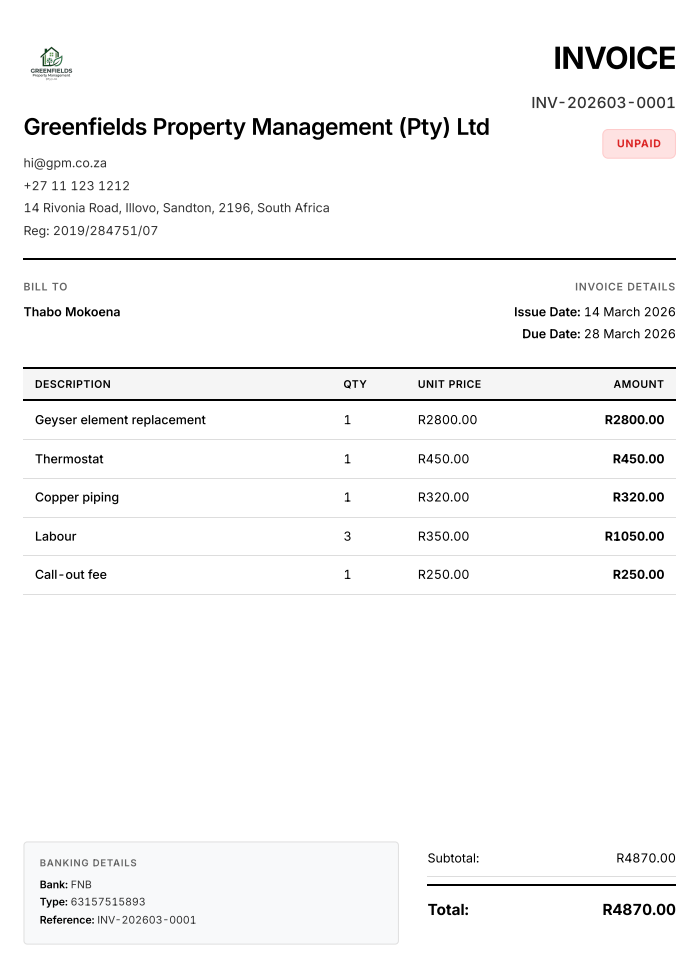
An actual invoice generated by wabill.
Non-VAT registered businesses
If you are not VAT registered (turnover below R1 million), your invoices should NOT include a VAT breakdown. Simply show the total amount. Important: do not add 15% and call it VAT. That is illegal if you are not registered.
Your invoice should still include your business name, client details, invoice number, date, description of work, amounts, and banking details. The only difference is no VAT line.
Record keeping for 2026
SARS requires you to keep financial records for:
- Tax invoices (issued and received): 5 years per VAT Act Section 55
- Income tax records: 5 years from date of submission per Tax Administration Act Section 29
- Provisional tax records: 5 years
- Employment records (payslips, IRP5s): 5 years after employment ends
With wabill, all your invoices are stored digitally and accessible anytime via WhatsApp. No paper filing needed.
Create invoices for 2026 on WhatsApp
Message wabill on WhatsApp and describe your invoice:
“Invoice ABC Company for consulting services R10,000”
We create a compliant invoice with current VAT calculations, your business details, and proper formatting. 10 free documents to start, then R150/month.
FAQ
What changed for invoicing in 2026?
The VAT rate remains at 15% (unchanged since April 2018). The VAT registration threshold is still R1 million/year. The main change for 2026/2027 is updated PAYE tax brackets (first bracket now R245,100 at 18%) and rebates (primary rebate R17,820). Invoice requirements under Section 20 of the VAT Act are unchanged.
Do I need a new invoice template for 2026?
Not necessarily. If your template includes the correct VAT rate (15%) and all Section 20 requirements, it's still valid. However, ensure dates, invoice numbers, and your business details are current. wabill always uses the latest requirements.
Is the VAT rate changing in 2026?
As of the 2025 Budget Speech, the VAT rate remains at 15%. There have been discussions about potential increases, but no change has been enacted. wabill will update automatically if the rate changes.
What are the current SARS invoice requirements?
For VAT-registered businesses, Section 20 of the VAT Act requires: the words 'Tax Invoice', your VAT number, buyer details (for invoices over R5,000), description of supply, amounts excl. and incl. VAT, and a unique invoice number. These requirements haven't changed.
10 free documents. No card needed.