How to Write a Quote in South Africa
A step-by-step guide to writing professional quotations that win work and protect your business.
A quote is a promise
Once a client accepts your quote, it becomes a binding agreement under South African contract law. Make sure your pricing and terms are accurate before sending it.
Step 1: Understand the scope
Before writing anything, make sure you understand exactly what the client needs. Visit the site if it's physical work. Ask questions:
- What exactly do they want done?
- What's the timeline?
- Are there any special requirements or constraints?
- Who is the decision-maker?
- Is this a competitive tender (are they getting multiple quotes)?
Step 2: Calculate your costs
Work out your actual costs before adding a margin:
- Materials: get supplier prices, add 10 to 20% for wastage
- Labour: your hourly rate x estimated hours
- Subcontractors: if outsourcing any part of the work
- Transport: fuel, vehicle wear, parking
- Overheads: insurance, tools, licences (spread across jobs)
- Profit margin: typically 15 to 30% depending on the industry
Step 3: Structure the quote
A professional quote should include these sections:
- Header: Your business name, contact details, logo
- Client details: Their name, company, and address
- Quote number and date
- Validity period (e.g., 'Valid for 30 days from date of issue')
- Scope of work: Detailed description of what you will do
- Itemised pricing: Each line item with quantity, unit price, and subtotal
- Exclusions: What is NOT included (prevents scope creep)
- VAT: If registered, show excl. VAT, VAT amount, and incl. VAT totals
- Payment terms: Deposit, milestones, or payment on completion
- Timeline: Estimated start date and duration
Step 4: Price correctly
Pricing strategies for South African small businesses:
Cost-plus pricing
Calculate all costs and add your margin. Most straightforward. Example: Materials R5,000 + Labour R8,000 + 20% margin = R15,600.
Value-based pricing
Price based on the value to the client, not your costs. A website that generates R50,000/month in leads is worth more than the hours you spend building it.
Market-rate pricing
Price in line with what others in your area charge. Useful when clients are comparing quotes. Research local rates before quoting.
Step 5: Handle VAT correctly
If you are VAT registered (compulsory above R1 million annual turnover under the Value-Added Tax Act 89 of 1991):
- Show all amounts excluding VAT
- Show the VAT amount (15%) as a separate line
- Show the total including VAT
- Include your VAT registration number
If you are not VAT registered, do not add VAT to your quote. Simply show the total amount. Adding VAT when you're not registered is illegal.
Step 6: Send and follow up
- Send the quote promptly. The first quote often wins
- Follow up within 3–5 days if you haven't heard back
- Be ready to clarify or revise. This is normal
- Once accepted, send a deposit invoice immediately
Example quote structure
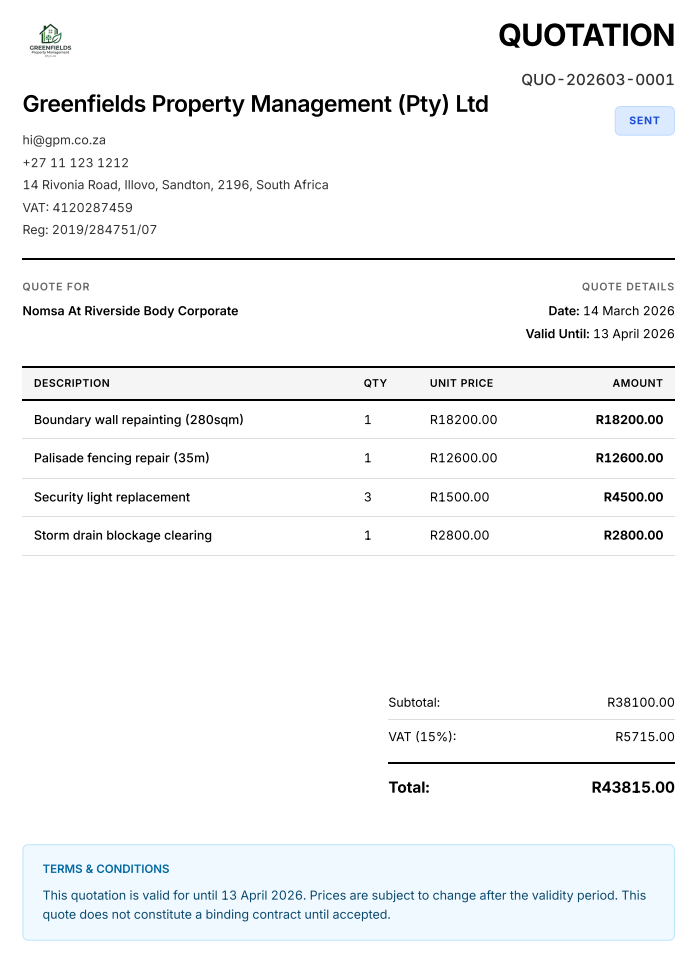
An actual quote generated by wabill.
Create quotes on WhatsApp
Skip the template. Message wabill on WhatsApp and describe the job:
“Quote for Mr Naidoo: bathroom renovation, tiles R8,000, plumbing R4,500, labour 5 days at R800, waterproofing R2,200. Valid 14 days. 50% deposit required.”
We create a professional PDF quote. When the client accepts, say “convert to invoice”. 10 free documents to start, then R150/month.
FAQ
What's the difference between a quote and an estimate?
A quote is a fixed price. Once the client accepts it, you're bound to that price. An estimate is an approximate figure that may change. If you're unsure of the final cost (e.g., repairs), provide an estimate and convert to a firm quote once the scope is clear.
How long should my quote be valid?
30 days is standard in most South African industries. Construction quotes often use 14 days due to fluctuating material prices. For professional services, 30–60 days is common. Always state the validity period clearly.
What if the client wants to negotiate the price?
It's normal. If you agree to a lower price, issue a revised quote with a new number. Never just change the original. Keep a paper trail. wabill makes it easy to create revised quotes.
Should I ask for a deposit?
Yes, for any project over R5,000 or where you need to purchase materials upfront. 50% deposit is standard in South Africa. State the deposit requirement on the quote. This protects you from no-shows and covers material costs.
10 free documents. No card needed.